Thursday, 31 March 2011
Tuesday, 8 March 2011
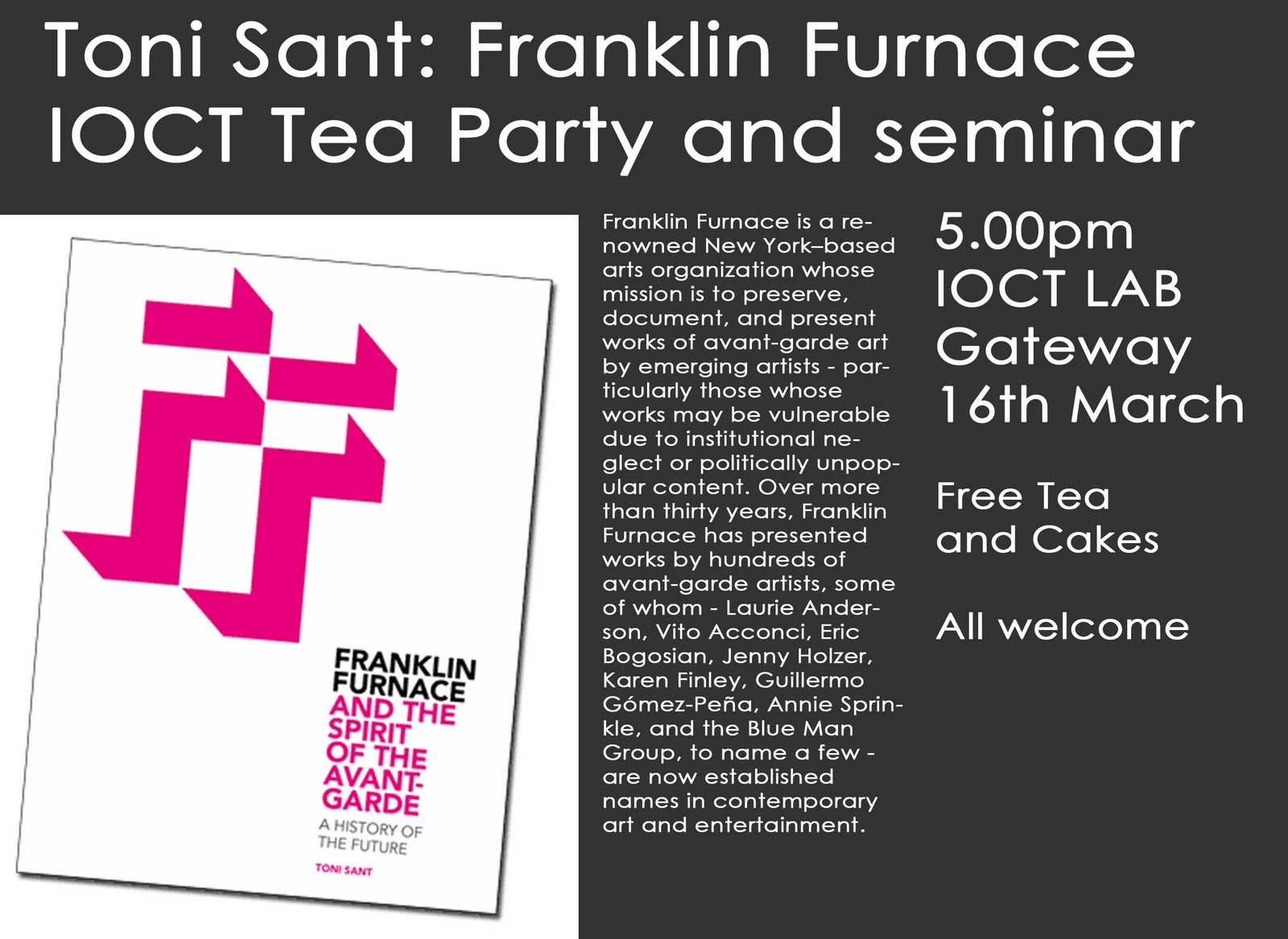
Toni Sant: Franklin Furnace
Toni Sant is Director of Research at the University of Hull’s School of Arts and New Media in Scarborough. He has also lectured about performance and new media at New York University and the University of Malta. http://www.tonisant.com
He will deliver a talk on the pioneering art of Franklin Furnace including Jenny Holzer and Laurie Anderson on wednesday 16th March at IOCT Lab on Gateway at 5.00pm
Monday, 28 February 2011
Codes of Disobedience & Dysfunctionality
The Hybrid City workshop:
Codes of Disobedience & Dysfunctionality
28 February - 4 March 2011
City intervention and Presentation of the work
at the National Museum of Contemporary Art, Athens, 5 - 25 March 2011
The University Research Institute of Applied Communication (URIAC), in
collaboration with the New Technologies Laboratory of the Faculty of
Communication and Media Studies, of the National and Kapodistrian University
of Athens, organise from the 28th until the 4th of March 2011 the workshop
"Codes of Disobedience & Dysfunctionality" led by the British artist Professor Martin
Rieser of IOCT, De Montfort University, in collaboration with an interdisciplinary team of artists, researchers and postgraduate students, as part of the action "Global
Gateway" and of the EU funded program "Civil Society Dialogue - Istanbul
2010 European Capital of Culture".
The aim of the workshop is to study the elements of the urban environment of
Athens and to form a new trail as a structure of narrative, thus enriching
the city with interactive content that reflects its contemporary
transformations. Inspired by the post¬ers and the graffiti encountered in
the city, and taking advantage of the possibilities given by mobile
communication technologies (GPS, QR codes etc) and the internet, the
workshop aims to connect the urban surroundings of Athens to opinions and
statements of its inhabitants regarding the challenges imposed by current
social, political, and financial circumstances; Anger, disobedience,
opposition, dysfunctionality. The features of the contemporary metropolis in
the midst of a period of crisis will be the main focus of the project,
posing at the same time questions about the role and mediation of technology
in urban everyday life. Can the new possibilities offered by technology
really capture the needs and the atmosphere of a city like Athens? Can
patterns and characteristics of urban life be identified when studying the
use of these communication systems?
The work that will be formed after the completion of the workshop will be
presented at the premises National Museum of Contemporary Art, on the
internet and in the center of the city (at the streets Skoufa - Navarinou -
Tzavela). From the 5th until the 25th of March the visitors of the museum
and inhabitants of Athens will be invited to follow the project's trail and
discover the different parts of the project's narration. Special QR codes
will be placed in selected locations of the city and by scanning them with a
mobile phone, access to the audiovisual material created during the workshop
will be given. Combining elements of installation art, urban intervention,
gaming and performance, "Codes of Disobedience & Dysfunctionality" reflects
Rieser's long term practice on art and technology.
Tuesday, 22 February 2011
Wireless City Amsterdam
Professor Martin Rieser spoke at a Conference
organized by the Mediafonds in collaboration with the Sandberg Institute at the state theatre in Amsterdam:
Wireless Stories. New Media in Public Space
A review of the day is below. In addition he participated in a one day masterclass with 8 potential teams for the Mediafons awards (€100000 per project ) at the Sandberg institute
________________________________________________________________________
Symposium Review
By:
Anja Groten
The
symposium was opened by the director of the Mediafonds Hans Maarten van den
Brink, followed by an introduction of the program by Annelys de Vet, director
of the design department at the Sandberg Institute and moderator of the day.
Annelys gave a brief insight in the current use of locative media. She spoke
about physical spaces that become digital and digital spaces that are
empathized more and more with the physical. As well she pointed out the current
urge of the topic, which was proofed by the huge amount of visitors attending
the conference (600 participants).
The first speaker of the morning block
about publicness, Michiel de Lange just finished his PHD about " Mobile
Media and Playful Identities". Lange gave a rather abstract and
theoretical view on "narrative" and the importance of storytelling, publicness and wireless
media".
He explained the narrative relates to human identity as human life can be seen
as a stage. Publicness, the
physical or media space furthermore is the space for similarities, the space
where we can share our stories. But publicness is
also a space of differences, which provides the possibility to remain private
and individual.
With his last point wireless media as the new way of
storytelling, Lange presented some actual examples, like Esther Polak's project
about tracing the milk trade (milkproject.net)
or the well known GPS city game Pac
Manhattan. (pacmanhattan.com)
Especially Polak's project shows well how
very complex and abstract content, such as the milk trade from Latvia to the
Netherlands, can be translated by the use of locative media to something visual
and accessible .
Dick van Dijk of the Waag Society showed as second
speaker how locative media can actively involve users and how it is able to
change behavior in public space.
One of the projects he showed was 7 scenes, a city game that makes the
history of Amsterdam accessible by actual experience. With this hands-on
project van Dijk demonstrated that apart from research and experimentation,
advanced technology can actually relate to society and is able to add value to
learning processes. The idea of 7
scenes is very simple. By actual walks with the historical map of
Amsterdam children could understand and remember information better than only
by reading or hearing about it.
(waag.org)
Helena Muskens and Quirine Racke were
introduced by an expressive performance of Annelys de Vet who suddenly
collapsed on the stage quite theatrically and apparently very convincing. Some
people were hearable shocked and shouted the light should be turned on. Parts
of the audience instead were less surprised and rather amused, since they were
already introduced to Annelys' extra ordinary presentation methods.
Eventually the light went on again and the
happening was dissolved by a movie about groups of people collapsing in public
space as flashmob-actions.
Following Muskens and Racke showed their
(less dramatical) movie Diamond
Dancers, which is about invisibility in public space.
The movie showed elderly ladies who are
dancing together some kind of square dance on Dam Square in Amsterdam. Although
the action of the dance was presented as a flash mob, the question was to
expect why this was considered a flash mob since the action was rehearsed and
staged and didn´t involve the use of social media. Unfortunately the question
remained unanswered.
Dimitri Nieuwenhuizen (lust.nl/lustlab.net), started as the
first speaker of the second block of lectures which had the focus of Audience and Interaction. He gave a
brief historical and anthropological tour of The Digital and showed amongst other examples the known
Lust-project where they turned the city of The Hague into an airport.
The question came up how the audience
reacted towards the highly visible intervention, which I thought was quite an
interesting question. "The pedestrians were more pleased than the
shop-owners and elderly people were afraid a war would start", was the
response with a little ironic undertone. The discussion of ethics,
responsibility unfortunately did not occur.
After the Danish PHD student Tobias Ebsen
gave a more than detailed insight in the institution he is operating in,
the Center of Digital Urban Living
(DUL) and the Media Facade
Research Group of the University of Aarhus, Denmark. The works he
showed all contained very big facades, which were transformed into interactive
platforms for self-expressions of the pedestrians. The impact of the projects
remained hidden behind rather sober explanation.
Matthijs ten Berge talked about Illuminate Outdoor Media and showed
the Moodwall which was a 24
meter long interactive media wall installed in the Bijlmer, Amsterdam.
Michael Epstein, CEO of Untravel Media (untravelmedia.com) as well as Martin
Rieser, professor of digital creativity, (martinreser.com, thirdwoman.com) introduced a focus on
storytelling, playfulness and gaming by using mobile technologies.
Epstein showed with three projects how
crime plots and dystopian fiction can literally become real. In "A Machine
to See With" the user is player and actor at the same time. Guided and
followed by a voice, which could be the voice of some kind of "Big Brother
melted with your therapist", the users was physically involved in a bank
robbery and sometimes even met other players/actors on the same mission.
Rieser gave some insights in The Third Woman, a dynamic crime story
with three alternative scripts which the user could choose from. The scripts
are written in fragments of about a minute. The more fragments watched the
closer a resolution of the mysterious "Third Woman".
While most of the talks were showing new
media as a playing field of experimentation in a creative but very abstract
way, the last talk A sense of Place by
Bregtje van der Haak changed the perspective on the subject matter to a very
personal and observing one.
Coming back from six month of teaching and
living in Hong Kong she presented images and small videos of her observations.
Those images were selected in a way they were telling not only the story of her
stay, but a story of a society which functions and behaves totally different
than our western society does. She spoke about people she met and their
stories, about the world as their stage, about the believe in the after-life as
an actual place and part of the whole, about the story of migrant workers and
their networked life and about the new center of the world, China.
It seemed the previous talks created a
consent as they all embraced technologies such as locative media as an exciting
and new field to explore. Hence the similarity of the lectures sometimes gave
the impression of repetition.
The personal approach of the last talk
instead added new perspectives and insights to the subject matter and was the
perfect ending of the whole event.
Thursday, 3 February 2011
Greenview Bid Success
Greenview
A £40,000 joint bid between IESD and IOCT to JISC for energy use visualisation through mobile phones and augmented reality has been successful
Overview
Greenview aims to follow on and build on the successful DUALL project, funded by phase 1 of JISC's Greening ICT call. DUALL utilised a socio-technical solution to the design of a simple web based information-feedback tool that could report electrical consumption of ICT equipment back to users. Greenview aims to refine the ICT tool further into a more sophisticated smart phone application that connects staff and students in De Montfort to the energy consumption of their buildings.Aims and objectives
Aim: To design a leading edge smart phone and web based application enabling building users to understand the energy consumption of the buildings across DMU.Objectives:
- To design and launch a campus wide ICT tool connecting building users to the energy consumption of buildings and the ICT infrastructure.
- To help the extent building users impact the performance of the environment they are in.
- To understand the potential of augmented reality tools to engage individuals in behaviour change initiatives.
- To engage the creative and developer community at DMU in sustainability issues
Project methodology
The project will gather the information from sub-meters across the campus which monitor half-hourly electricity, gas and water.Software will incorporate the design of major interface components, including collaborative gaming elements, display alternatives, (adaption of map-based and Augmented reality systems for mobile platforms using GPS) using streamed data sets from intelligent metering and its required interpretive software.
Technology such as social media, augmented reality, GPS technology, and wiki or crowd-sourcing knowledge approaches to engage with the public in what we would term "hybrid " city environments.
This ability to reach out and map layers of information onto the cityscape will form the foundation for further developments to support this bid. Pilot interface tests will occur in situ with a variety of controlled groups for evaluation in set scenarios of components: display overlays, collaborative elements etc.
Finally, the tool will be launched across the campus and a rigorous analysis undertaken based on the evidence of any changes to consumption (as shown in the meter readings) and interviews.
Anticipated outputs and outcomes
We anticipate that the outcomes of the project will form an institutional exemplar project that places sustainability at the core of DMU's CSR agenda, and connects into the aim of the JISC Institutional Innovation Programme to provide "improved leadership to the sector in the role that technology can play in developing effective institutional strategies."Specifically there will be a campus wide ICT tool (using augmented reality) connecting building users to the energy consumption of buildings and the ICT infrastructure. This will be open source and available for download by other HEIs.
Project Staff
Project Manager: Dr Richard Bull IESD (DMU)
Project Team:Professor Martin Rieser
Institute of Creative Technologies (DMU)
Dave Everitt
Institute of Creative Technologies (DMU)
Gareth Howell
Institute of Creative Technologies (DMU)
Farhan Faruk
IESD (DMU)
Thursday, 20 January 2011
Adaptations and New Media Symposium
A Symposium on Adaptation for New Media
January 25, 2011 Hugh Aston Building De Montfort University
The Department of English's Adaptation studies and the IOCT have joined forces to co-host a one day symposium on the changing nature of adaptation in relation to new media forms. The symposium brings together academics from across the UK and Europe to focus on the new problems associated with adaptation for such diverse platforms as gaming and the Web.It features papers ranging from
computer games, mash‐ups, interactive narratives and interactive film, technological innovations, representations of technology and new media.
The conference is open to anyone interested in how the entertainment
industry is constantly adapting to new technologies. The conference will
be introduced by award winning writer, Kate Pullinger, who will talk on
Nothing New Here: Books as Apps, Enchanced e‐Books, and Digital
Stories’, relating her own experience with the ‘enhanced abridged audio
ebook’ adaptation of her 2009 novel, The Mistress of Nothing. The
conference will close with a screening of Martin Rieser’s The Third
Woman interactive film for mobiles based on The Third Man
We intend to publish the three best papers in a special edition of
Adaptions Journal and the remainder can be published online on a
dedicated website
Ernest Edmonds Talk
The Institute of Creative Technologies and the Computer Arts Society jointly hosted a well-attended talk by Ernest Edmonds at 5pm on 19th January at the IOCT Lab at De Montfort University
Biography
Ernest Edmonds was born in London and studied Mathematics and Philosophy at Leicester University. He has a PhD in logic from Nottingham University, is a Fellow of the British Computer Society, a Fellow of the Institution of Engineering and Technology and a Charted Engineer. He is a practicing artist.
He lives and works in Sydney Australia. His art is in the constructivist tradition and he first used computers in his art practice in 1968. He first showed an interactive work with Stroud Cornock in 1970. He first showed a generative time-based computer work in London in 1985. He has exhibited throughout the world, from Moscow to LA. The Victoria and Albert Museum, London, is collecting his archives within the National Archive of Computer Based Art and Design.
He has over 200 refereed publications in the fields of human-computer interaction, creativity and art. Artists Bookworks (UK) has recently published his book "On New Constructs in Art". Ernest Edmonds is Professor of Computation and Creative Media at the University of Technology, Sydney where he runs a multi-disciplinary practice-based art and technology research group, the Creativity and Cognition Studios. In Sydney, he is represented by the Conny Dietzschold Gallery.
Ernest Edmonds has held the position of University Dean, has sat on many funding and conference committees and was a pioneer in the development of practice-based PhD programmes. He founded the ACM Creativity and Cognition Conference series and was part of the founding team for the ACM Intelligent User Interface conference series. He has been an invited speaker in, for example, the UK, France, the USA, Australia, Japan and Malaysia.
Editor-in-Chief Leonardo TransactionsFounding Editor Knowledge-Based SystemsVisiting Professor Sussex UniversityVisiting Research Fellow Goldsmiths College
Subscribe to:
Posts (Atom)