Showing posts with label digital arts. Show all posts

Saturday, 29 September 2012

ISEA 2012

ISEA2012 Machine Wilderness


As contradictory as it sounds to hold a conference/exhibition on ecology in a remote location among the fragile sands of New Mexico,  ISEA12 had an ecological theme "Machine Wilderness". The associated air miles and car use were the unfortunate overheads. Outstanding works included François Quévillon's Derive (video) which visualised weather data embedded in the drawing of a reactive 3D graphic landscape. It was remarkable in its subtle rendering and potential for showing data in intuitive ways.
Other top works included The Hand of Man in Taos, 

The Hand of Man-Christian Ristow
A gigantic hydraulic hand driven by a data glove which was capable of lifting and crushing cards bodily. "The Hand of Man" moving sculpture by Christian Ristow, September 27 through to  30th , in Kit Carson Park is an interactive kinetic sculpture that you can operate. People were able to work with the artist and crew by slipping theirr hand into the sculpture's operation glove - a system that enables the giant sculpture to mimic your movements.  You can pick up cars that will be part of the exhibit, lift them 25 feet up, turn them about, and drop them to the ground! The Hand was designed and built by Ristow, a renowned artist in the field of animatronics. Ristow has been living and working in Taos since 2005, and built The Hand in 2008.  

Teri Rueb, Carmelita Topaha &  Larry Phan: No Places with Names: A Critical Acoustic Archaeology locative wilderness walk has already been blogged here, but Charles Lindsay: CARBONX  Dome piece also at Sante Fe, was another overwhelming experience.
The Sante Fe day included a visit to SITE whose More Real? Art in the Age of Truthiness show was a knock out-albeit not particularly electronic ( In collaboration with the Minneapolis Institute of Arts. The exhibit will be on display until January 6th, 2013.)
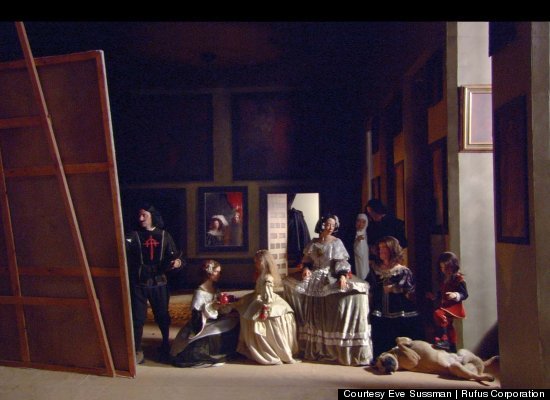
Eve Sussman video still from "89 Seconds at Alcázar"Los Meninas

.

For me the out standing works were artist Inigo Manglano-Ovalle's replica of the chemical-weapon-baring trucks Colin Powell recollected from Iraq. And others focused more heavily on the technological advancements that blurred the line between documentation and reappropriation, such as Eve Sussman's video installation that recreates the scene of Diego Velazquez's "Las Meninas."

50/50 Native Artists in Sa
50/50: Fifty Artists, Fifty Years presented by Museum of Contemporary Native Arts was an overwhelmingly sad experience , with every work reflecting confusion , anger and despair at the native dispossion and the tainting of Indian lands with radioactive fall out from Nuclear tests.

This exposed the contradictory nature of the whole event: sensitive eco-friendly projects addressing the despoiling of the wilderness by man's careless interventions, at the same time endorsing low rider and car-centered cultures in the region, and very little said about the grab for oil, the arctic sea ice melting the move away from nuclear and the terrifying future that global warming will bring. It was not complacent, but seemed far from the European consciousness about the global climate crisis and tthe radical changes needed. 
Steve Storz  Kanobis Amplifier Research Facility
On Taos day the sinister shed by Steve Storz  Kanobis Amplifier Research Facility (KARF) Phase II at the  UNM Klauer Campus in Taos NM, was an outdoor electronic sculpture installation that underlined the complicity of scientists in despoiling this pristine landscape in the name of 'freedom'.
However the focus on building DIY adobe shacks at Taos seemed nice and hippyish, but is not a realistic long-term solution. Engaging with Los Alamos was also a nice idea, but the attitudes revealed at the Sante Fe conference by the artistic director, implied a massive misunderstanding of the role of art:  seeing it only as a way of illustrating existing scientific materials more effectively, rather than as a radical way of completely rethinking methodologies.

The small contribution we made as a team ( Nina Yankowitz, Barry Holden , Martin Rieser, Rasmus Vuiori) was an interactive questionnaire using QR codes to probe the contradictions in people's attitudes to Eco issues. The resulting web database will be used to drive future online interventions using avatar humour to engage a thoughtful response to the crisis.

The main exhibition for ISEA2012 was displayed at a total of seven venues. It is based at both The Albuquerque Museum of Art & History and 516 ARTS, with off-site projects at the following five Anderson-Abruzzo Albuquerque International Balloon Museum, the New Mexico Museum of Natural History, the Rainosek Gallery at the UNM School of Architecture & Planning, Richard Levy Gallery and the Alvarado Urban Farm. The exhibition features work that combines art, science and technology, demonstrating the role art can play in re-envisioning the world. The over 100 artists are from 16 countries: Austria, Brazil, Canada, Finland, France, Germany, Italy, Korea, Mexico, The Netherlands, New Zealand, Portugal, Scotland, Spain, the U.K. and the USA. The exhibition was juried and curated through an international call for proposals, which drew close to 1,500 submissions from artists and presenters around the globe. The exhibition is accompanied by a catalogue published by the acclaimed Radius Books, which will be distributed internationally. 
It was a massive attempt to integrate electronic arts and the ecologic movement and as such deserves praise for both ambition and achievement. 
Posted by

Wednesday, 12 September 2012

Secret Garden

 
Secret Garden
A virtual reality/augmented reality hybrid performance opera/ballet.
 Martin Rieser/ Andrew Hugill
Introduction

Secret Garden is an attempt to recreate a contemporary version of the Eden myth in the midst of an urban environment. It will be available in two versions –a physical installation and as a virtual mobile experience linked to selected site locations. In its installation aspect, it will comprises eleven mounted iPads acting as viewports distributed around a circle in the Cube gallery at Phoenix Square. Peering into one of the viewports will trigger a view of an idyllic three-dimensional scene in the ‘Secret Garden’ and tell part of the mythical story of the Fall, through words, music and dance. This same content will soon be made available using Augmented Reality software to any visitor with a smartphone.

The Fall story is common to many of the world’s religions, including Judaism, Christianity and Islam. The structure of Secret Garden will be loosely modelled on the ten paths of the Sephirot in the Jewish telling of the story, which is itself also a symbol of the Tree of Life and the oldest extant version. Two contemporary human figures re-enact the story of the Fall, combining sung poetry and video vignettes with 3D generated environments, each scene dis­tributed to a different one of the eleven iPad viewports. The viewer’s presence triggers both music and action.
The texts comprise original poems that tell this classic story in a timeless and relevant way, examining choices in a fallen world. The musical composition is adaptive and features vocal settings and digitally treated percussion. The virtual scenography consists of 3D designs based on an idealised garden space, inspired by the 19th century Mezzotints for Milton’s Paradise Lost by John Martin. Viewing the eleven viewports will gradually assemble the elements of a story in the user’s mind. The story is mysterious and mythical in nature, however, it is not necessary to see the viewports in any particular order, and a partial viewing will also provide a complete experience in itself.
 The installation is a unique virtual reality amalgam of poetry, music, and 3D panoramic images and motion-captured avatars. It plays with sound narrative and myth, transposed into a modern context, using technology both in production and delivery in a synthesised and holistic capacity. Audience movement from viewport to viewport will trigger vocal settings of authored verse  and head movements change the scene perspective in realtime.

The Institute Of Creative Technologies (IOCT) at De Montfort University supported the project. The IOCT specialises in cross-disciplinary working that combines science and technology with the arts and humanities. The project will draw on expertise from the Faculties of Art & Design, Humanities and Technology, including the Fused Media Lab (for the virtual scenography), the Architecture Department (for the physical build of the installation), students on the Games Design degree (for the interactivity) and the Music, Technology and Innovation Research Centre (for the music). Management will be provided by Professor Andrew Hugill (Director of the IOCT) and Professor Martin Rieser (Professor of Digital Creativity), who are the creators of Secret Garden.


Tuesday, 14 August 2012

EXODUS

FROM KAMPALA TO LEICESTER


Exodus

Martin Rieser - Institute of Creative
Technologies at De Montfort University

Audio Trail and Installations
14th August – 30th September


Sean Clark programmer testing Trail

Wall trail in Phoenix Cafe


Interactive Video multi-scree


This digital commission in one of a series of events and activities across Leicester that marksthe 40th anniversary of the expulsion ofUgandan Asians and their subsequent move to Leicester.

In August 1972, Ugandan dictator Idi Amin gave the Asian community 90 days notice to
leave the country. They were forced to leavealmost everything in Uganda and seek refuge in other countries such as Britain and Canada. The digital commission consists of a trail linking New Walk Museum and Art Gallery and Phoenix, a video installation in the Phoenix café multiscreen and a large wall graphic showing the trail and providing access to QR codes, located in the Phoenix café.

Trail
New Walk Museum & Art Gallery
to Phoenix

Using personal testimony from Leicester’s Ugandan Asian community, the trail revisits the
dramatic events in 1972 and shares memories about arrival in the UK and settling in Leicester ithe 1970s, while celebrating the community’s continued cultural and economic impact on the City.

The trail follows a route from New Walk Museum & Art Gallery to Phoenix, with QR codes located on posters in shops and windows along the route. Scanning the QR codes triggers the audio commentary telling the story of the exodus. Onarrival at Phoenix, visitors can interact with the video installation and wall graphic in the café area.

To follow the trail, iPhone users should download an app from Empedia, via www.empedia.info. You can then follow the trail, scanning the QR codes located along the walk (or on the map on the reverse) to release audio information. The map on the reverse can be used as a route guide. Android phone users can follow the trail without downloading the app, provided they have a QR  code reader downloaded on their phone. For iPhone users, information on the trail can also be triggered by GPS position if this facility is
active on your phone. By using this trail, you willbe downloading data to your phone, and your network provider may charge for this.

Installation
Phoenix Cafebar

When you arrive at Phoenix, the video installation on the café multiscreen allows you to edit your own journey through videos created specially for this commission.

The videos celebrate the current exhibition at New Walk Museum & Art Gallery, using film footage of journeys across narrative textile surfaces. The textiles were created by community groups and professional artists, with lead artist Ashok Mistry, for the ‘from Kampala to Leicester’ exhibition at New Walk Museum & Art Gallery.

This video installation is a unique development using iPhone or iPad tones to control the nine video windows. You can visit reception to borrowearphones and iPads to participate - just plug into the wall fitting and edit your own journey through the videos.

The large wall graphic allows you to follow the audio trail in the comfort of Phoenix’s café. Scan the QR codes to trigger the audio commentary using iPads, iPhones or android phones.

See the website for event details, including the digital commission and screenings at Phoenix Square and a range of activities at New Walk


Please be aware that some of the testimonies in
the trail contain information that some people may
find upsetting

Friday, 4 November 2011

Santa Fe International New Media Festival
June 22 – July 8, 2012
Call for New Media Submissions
currents 2012, the 3rd annual Santa Fe International New Media Festival will be held in Santa Fe, New Mexico, USA – June 22 – July 8, 2012.  The Festival explores the role of technology and the diverse applications of New Media in the arts.
This year submission categories include single channel video, video and sound installation, interactive new media, animation, computer/software modulated sculpture, multimedia performance, experimental and interactive documentary video, Digital Dome projection, art gaming and web art.
The Festival will be held in several venues throughout the city: El Museo Cultural de Santa Fe, the Center for Contemporary Arts, the Santa Fe Complex and the Digital Dome facility at the Institute for American Indian Arts. In addition to exhibitions currents 2012 will offer panel discussions and workshops, and two nights of multimedia performance. Festival events are free to the public.
Application Deadlines (via online submission or postmarked):
February 1, 2012 (most festival submissions)
March 1, 2012 for Digital Dome Submissions
For Application Guidelines and Submission Forms:
http://www.currentsnewmedia.org/submissionguidel.html
To view archives of previous festival exhibitions:
http://www.currentsnewmedia.org/currents2012.html

Wednesday, 28 September 2011

Sean Clark and Fabrika Arts Centre: Interact Gallery

Digital artist and IOCT PhD student Sean Clark launched the Interact Gallery on 5th September  at the Fabrika Arts Centre. Leicester's newest gallery for interactive and digital arts opened today on the first floor of Fabrika, in Humberstone Gate. It will act as a showcase for the best art works in the East Midlands and will be curated jointly by Sean Clark, De Montfort University and Adam Kirk of Fabrika. 

The show  runs until late October and the organisers hope that would-be artists will offer their works to the rolling programme, during which exhibits will be changed regularly.
Speaking at the opening, Sean Clark said "The transformation of the upstairs space is still underway but it is hoped to be completed in two weeks time. Over the next two months we plan to show the work of up and coming digital artists."

memory mirrors


On show at present are a number of works by Sean Clark, such as his Memory Mirror, which captures video images of people walking in front of it and plays them back as ghostly images.

drop sketch

His work Drop Sketch is a wall of graphical images provided by people from their mobile phones, to which they have downloaded a special app. that allows them to make a sketch and upload it to the central gallery. 

moving circles

Another panel shows a group of moving circles that nteracts with the viewer.


Also speaking the Launch event was Professor Ernest Edmonds, from IOCT De Montfort University, who told the meeting "innovations in interactive arts have often involved small and select groups of people. This gallery is ideal for interactive work. Leicester has had a strong tradition in this area over a long period of time. It was one of the first cities to mount an early exhibition of interactive art back in 1970/71, in what was then Leicester Polytechnic.
It was Albert Einstein who said that 'inventing the problem is more important than solving it.' This very much sums up what this exhibition is about.Leicester has for a long time been noted for its adventurous and experimental artists. Buckminster Fuller came here in 1971",  he said recounting some of the early approaches to interactive art experiments. Fuller was an engineer, designer, inventor and systems theorist. He invented the architecture of the geodesic dome

A book is due out in November which Ernest Edmonds has edited with Linda Candy: Interacting: art, research and the creative practitioner, to be published by Libri. In it, contributors will consider the many forms of interaction involved in the arts and in creative processes.

"I look forward to seeing the gallery playing its part in innovation and risk-taking as part of the artistic process, " Prof. Edmonds said. 

More information is available from the Interact Gallery web site.

Saturday, 24 September 2011

The Future of Locative Media

Mark Tuters at ISEA 2011in Istanbul spoke of the spectrum of media art practice in the mobile arena as ranging from the personal and local to the relational and transposable. He acknowledged the fetishisation of the local, but held open the medium’s potential for challenging the exploitative effects of globalisation on hidden labour by tracking all product components. Site-specific thus becomes ‘tracing the elsewhere”. 

For me this data as power proposition still fell within the realm radical individualism and so was still inside the framework of the neo-liberal project. Mark Shephard on the same panel spoke of ubiquitous conditions and the new possibilities for new media détournment 45 years after the Situationists. He suggested artists should abandon the locative as the dominant frame and add on the concepts of time and identity to enlarge the artistic possibilities of the medium. Ludic Being might be the new mode for Situationist media. The visual examples he juxtaposed were parcours runners in a Russian estate (as modern examples of détourment) with a clip from Cliff Oakley’s dystopian film The Catalogue where consumer profiling and surveillance meet in grim harmony. I think what we could postulate is rather that there are two domains-the “digital tame” of social media, online consumer culture and even radical digital arts and the “wild” of critical conditions in the world where poverty and disempowerment have yet to find a political voice in pervasive digital art.

I believe both speakers are still working within the paradigm that existed before the demise of the neo-liberal economic project and that collective and focused action through pervasive media art , which has some idea of where it would like to move the dominant ideas, is an altogether more difficult and painful proposition, but one where Mark Shephard’s extension of the frame could be the most readily applied and move beyond individual détournment to something more coherent in terms of collective ideas and commitment.

Thursday, 31 March 2011

Urban Digital Narratives: Athens


Martin Rieser will be conducting another locative media workshop in Athens in early April to test the Empedia software, developed under an sKTP with Cuttlefish Multimedia. He will also participate in a one day symposium at the Centre for Research in Athens, sponsored by the British Council and HTC

Tuesday, 8 March 2011

Toni Sant: Franklin Furnace


Toni Sant is Director of Research at the University of Hull’s School of Arts and New Media in Scarborough. He has also lectured about performance and new media at New York University and the University of Malta. http://www.tonisant.com

He will deliver a talk on the pioneering art of Franklin Furnace including Jenny Holzer and Laurie Anderson on wednesday 16th March at IOCT Lab on Gateway at 5.00pm


Monday, 28 February 2011

Codes of Disobedience & Dysfunctionality


The Hybrid City workshop:
 Codes of Disobedience & Dysfunctionality
 28 February - 4 March 2011

City intervention and Presentation of the work
 at the National Museum of Contemporary Art, Athens, 5 - 25 March 2011


The University Research Institute of Applied Communication (URIAC), in
collaboration with the New Technologies Laboratory of the Faculty of
Communication and Media Studies, of the National and Kapodistrian University
of Athens, organise from the 28th until the 4th of March 2011 the workshop
"Codes of Disobedience & Dysfunctionality" led by the British artist Professor Martin
Rieser of IOCT, De Montfort University, in collaboration with an interdisciplinary team of artists, researchers and postgraduate students, as part of the action "Global
Gateway" and of the EU funded program "Civil Society Dialogue - Istanbul
2010 European Capital of Culture".

The aim of the workshop is to study the elements of the urban environment of
Athens and to form a new trail as a structure of narrative, thus enriching
the city with interactive content that reflects its contemporary
transformations. Inspired by the post¬ers and the graffiti encountered in
the city, and taking advantage of the possibilities given by mobile
communication technologies (GPS, QR codes etc) and the internet, the
workshop aims to connect the urban surroundings of Athens to opinions and
statements of its inhabitants regarding the challenges imposed by current
social, political, and financial circumstances; Anger, disobedience,
opposition, dysfunctionality. The features of the contemporary metropolis in
the midst of a period of crisis will be the main focus of the project,
posing at the same time questions about the role and mediation of technology
in urban everyday life. Can the new possibilities offered by technology
really capture the needs and the atmosphere of a city like Athens? Can
patterns and characteristics of urban life be identified when studying the
use of these communication systems?

The work that will be formed after the completion of the workshop will be
presented at the premises National Museum of Contemporary Art, on the
internet and in the center of the city (at the streets Skoufa - Navarinou -
Tzavela). From the 5th until the 25th of March the visitors of the museum
and inhabitants of Athens will be invited to follow the project's trail and
discover the different parts of the project's narration. Special QR codes
will be placed in selected locations of the city and by scanning them with a
mobile phone, access to the audiovisual material created during the workshop
will be given. Combining elements of installation art, urban intervention,
gaming and performance, "Codes of Disobedience & Dysfunctionality" reflects
Rieser's long term practice on art and technology.

Tuesday, 22 February 2011

Wireless City Amsterdam

Professor Martin Rieser spoke at a Conference organized by the Mediafonds in collaboration with the Sandberg Institute at the state theatre in Amsterdam: 
Wireless Stories. New Media in Public Space
A review of the day is below. In addition he participated in a one day masterclass with 8 potential teams for the Mediafons awards (€100000 per project ) at the Sandberg institute


________________________________________________________________________


Symposium Review
By: Anja Groten

The symposium was opened by the director of the Mediafonds Hans Maarten van den Brink, followed by an introduction of the program by Annelys de Vet, director of the design department at the Sandberg Institute and moderator of the day. Annelys gave a brief insight in the current use of locative media. She spoke about physical spaces that become digital and digital spaces that are empathized more and more with the physical. As well she pointed out the current urge of the topic, which was proofed by the huge amount of visitors attending the conference (600 participants). 

The first speaker of the morning block about publicness, Michiel de Lange just finished his PHD about " Mobile Media and Playful Identities". Lange gave a rather abstract and theoretical view on "narrative" and the importance of storytelling, publicness and wireless media".
He explained the narrative relates to human identity as human life can be seen as a stage. Publicness, the physical or media space furthermore is the space for similarities, the space where we can share our stories. But publicness is also a space of differences, which provides the possibility to remain private and individual. 
With his last point wireless media as the new way of storytelling, Lange presented some actual examples, like Esther Polak's project about tracing the milk trade (milkproject.net) or the well known GPS city game Pac Manhattan. (pacmanhattan.com)
Especially Polak's project shows well how very complex and abstract content, such as the milk trade from Latvia to the Netherlands, can be translated by the use of locative media to something visual and accessible .

Dick van Dijk of the Waag Society showed as second speaker how locative media can actively involve users and how it is able to change behavior in public space. 
One of the projects he showed was 7 scenes, a city game that makes the history of Amsterdam accessible by actual experience. With this hands-on project van Dijk demonstrated that apart from research and experimentation, advanced technology can actually relate to society and is able to add value to learning processes. The idea of 7 scenes is very simple. By actual walks with the historical map of Amsterdam children could understand and remember information better than only by reading or hearing about it.

Helena Muskens and Quirine Racke were introduced by an expressive performance of Annelys de Vet who suddenly collapsed on the stage quite theatrically and apparently very convincing. Some people were hearable shocked and shouted the light should be turned on. Parts of the audience instead were less surprised and rather amused, since they were already introduced to Annelys' extra ordinary presentation methods.
Eventually the light went on again and the happening was dissolved by a movie about groups of people collapsing in public space as flashmob-actions.

Following Muskens and Racke showed their (less dramatical) movie Diamond Dancers, which is about invisibility in public space. 
The movie showed elderly ladies who are dancing together some kind of square dance on Dam Square in Amsterdam. Although the action of the dance was presented as a flash mob, the question was to expect why this was considered a flash mob since the action was rehearsed and staged and didn´t involve the use of social media. Unfortunately the question remained unanswered. 

Dimitri Nieuwenhuizen (lust.nl/lustlab.net), started as the first speaker of the second block of lectures which had the focus of Audience and Interaction. He gave a brief historical and anthropological tour of The Digital and showed amongst other examples the known Lust-project where they turned the city of The Hague into an airport. 
The question came up how the audience reacted towards the highly visible intervention, which I thought was quite an interesting question. "The pedestrians were more pleased than the shop-owners and elderly people were afraid a war would start", was the response with a little ironic undertone. The discussion of ethics, responsibility unfortunately did not occur.

After the Danish PHD student Tobias Ebsen gave a more than detailed insight in the institution he is operating in, the Center of Digital Urban Living (DUL) and the Media Facade Research Group of the University of Aarhus, Denmark. The works he showed all contained very big facades, which were transformed into interactive platforms for self-expressions of the pedestrians. The impact of the projects remained hidden behind rather sober explanation.

Matthijs ten Berge talked about Illuminate Outdoor Media and showed the Moodwall which was a 24 meter long interactive media wall installed in the Bijlmer, Amsterdam. 

Michael Epstein, CEO of Untravel Media (untravelmedia.com) as well as Martin Rieser, professor of digital creativity, (martinreser.comthirdwoman.com) introduced a focus on storytelling, playfulness and gaming by using mobile technologies.

Epstein showed with three projects how crime plots and dystopian fiction can literally become real. In "A Machine to See With" the user is player and actor at the same time. Guided and followed by a voice, which could be the voice of some kind of "Big Brother melted with your therapist", the users was physically involved in a bank robbery and sometimes even met other players/actors on the same mission.

Rieser gave some insights in The Third Woman, a dynamic crime story with three alternative scripts which the user could choose from. The scripts are written in fragments of about a minute. The more fragments watched the closer a resolution of the mysterious "Third Woman".

While most of the talks were showing new media as a playing field of experimentation in a creative but very abstract way, the last talk A sense of Place by Bregtje van der Haak changed the perspective on the subject matter to a very personal and observing one.
Coming back from six month of teaching and living in Hong Kong she presented images and small videos of her observations. Those images were selected in a way they were telling not only the story of her stay, but a story of a society which functions and behaves totally different than our western society does. She spoke about people she met and their stories, about the world as their stage, about the believe in the after-life as an actual place and part of the whole, about the story of migrant workers and their networked life and about the new center of the world, China.

It seemed the previous talks created a consent as they all embraced technologies such as locative media as an exciting and new field to explore. Hence the similarity of the lectures sometimes gave the impression of repetition. 
The personal approach of the last talk instead added new perspectives and insights to the subject matter and was the perfect ending of the whole event.


Thursday, 20 January 2011

Adaptations and New Media Symposium


A
 Symposium
 on
 Adaptation
 for
 New 
Media

January
 25,
 2011
 Hugh
 Aston 
Building
 De
 Montfort 
University

The Department of English's Adaptation studies and the IOCT have joined forces to co-host a one day symposium on the changing nature of adaptation in relation to new media forms. The symposium brings together academics from across the UK and Europe to focus on the new problems associated with adaptation for such diverse platforms as gaming and the Web.It 
features 
papers 
ranging
 from

computer
games,
 mash‐ups, 
interactive 
narratives 
and 
interactive 
film,
 technological 
innovations,
 representations
 of 
technology 
and 
new 
media.


The
 conference 
is open 
to 
anyone 
interested 
in 
how
 the 
entertainment

industry is 
constantly
 adapting 
to 
new
 technologies.


The 
conference
 will

be 
introduced 
by 
award 
winning
 writer,
 Kate
Pullinger,
 who 
will 
talk
 on

Nothing 
New 
Here:
Books 
as
 Apps,
Enchanced
 e‐Books,
 and 
Digital

Stories’,
 relating 
her 
own
 experience 
with 
the
‘enhanced 
abridged 
audio

ebook’ 
adaptation
 of 
her
 2009
 novel,
 The
 Mistress
 of 
Nothing.

The

conference 
will
 close 
with 
a
 screening of
 Martin
Rieser’s
 The Third

Woman interactive film for mobiles based on The Third Man

We 
intend
 to 
publish 
the 
three
 best 
papers 
in 
a 
special
 edition
 of

Adaptions 
Journal
 and
 the
 remainder 
can 
be
 published 
online
 on 
a

dedicated
 website


Ernest Edmonds Talk


The Institute of Creative Technologies and the Computer Arts Society jointly hosted  a well-attended talk by Ernest Edmonds at 5pm on 19th January at the IOCT Lab at De Montfort University


Biography

Ernest Edmonds was born in London and studied Mathematics and Philosophy at Leicester University. He has a PhD in logic from Nottingham University, is a Fellow of the British Computer Society, a Fellow of the Institution of Engineering and Technology and a Charted Engineer. He is a practicing artist.

He lives and works in Sydney Australia. His art is in the constructivist tradition and he first used computers in his art practice in 1968. He first showed an interactive work with Stroud Cornock in 1970. He first showed a generative time-based computer work in London in 1985. He has exhibited throughout the world, from Moscow to LA. The Victoria and Albert Museum, London, is collecting his archives within the National Archive of Computer Based Art and Design.

He has over 200 refereed publications in the fields of human-computer interaction, creativity and art. Artists Bookworks (UK) has recently published his book "On New Constructs in Art". Ernest Edmonds is Professor of Computation and Creative Media at the University of Technology, Sydney where he runs a multi-disciplinary practice-based art and technology research group, the Creativity and Cognition Studios. In Sydney, he is represented by the Conny Dietzschold Gallery.

Ernest Edmonds has held the position of University Dean, has sat on many funding and conference committees and was a pioneer in the development of practice-based PhD programmes. He founded the ACM Creativity and Cognition Conference series and was part of the founding team for the ACM Intelligent User Interface conference series. He has been an invited speaker in, for example, the UK, France, the USA, Australia, Japan and Malaysia.

Editor-in-Chief Leonardo Transactions
Founding Editor Knowledge-Based Systems
Visiting Professor Sussex University
Visiting Research Fellow Goldsmiths College

Wednesday, 19 January 2011

SKTP for DH Lawrence Trail

About Empedia

Empedia is a growing collection of online maps, audio tours, picture trails,video and interactive guides. It's designed for curators of cultural venues, organisations and attractions and for visitors and residents within the East Midlands region. The Empedia Platform is being developed by Cuttlefish Multimedia as part of the Renaissance East Midlands MLA Programme and is part funded by an sKTP Knowledge Transfer partnership with DMU


One of the first commissions on which IOCT is collaborating is a DH Lawrence trail around Lawrence's birthplace in Eastwood near Nottingham-due to be launched in June 2011


Guides are available via the Empedia website, iPhone App and the Empedia Player which can be embedded in other websites.

Plan, Assemble, Edit, Publish...

Planning Your Trail or Exhibition

Firstly, plot a route for your cultural guide on a map or plan of your venue, identifying key points of interest. Points can form a linear trail or be completely random. In some cases, multiple trails may be necessary, each having its own interpretation or narrative. If you have existing Google Maps, Empedia can also import trail data in standard KML format.

Gathering Content

The next task involves collecting existing media or generating new content for each of the points of interest. In its simplest form this can involve repurposing the content of a leaflet as the basis of your Empedia guide. All content is digitised to the required formats and uploaded to the Empedia website via a password-protected login area. The Cuttlefish team can assist with this process. Empedia supports text, images, audio and video in a variety of formats. You can also include existing media from Flickr and YouTube.

Content Editing and Management

Each media resource (picture, text, audio clip, etc) can be positioned on a guide map or plan using simple 'drag-and-drop' techniques. For pin-point accuracy, Latitude/Longitude co-ordinates can also be input if required.
In the desktop version of Empedia, all of the media resources for an individual guide are displayed in a sequential list at the bottom of the player. Changing the position of media resources in the sequential list is achieved via a simple drop down box. (Drag-and-drop editing coming soon). Media resources can also be stacked together in one location (an image might be combined with several audio clips, for example).

One-click Publishing

All editing operations are conducted 'behind-the-scenes' in draft mode prior to public release. Empedia's one-click publishing updates the public-facing website, embedded players and iPhone App simultaneously.

User Interface

Media resources are activated (narration, pictures, descriptions, etc) by clicking icons on the map or clicking thumbnail images in a sequential list. The Empedia iPhone App has additional 'locative' methods of activating resources, utilising mobile GPS and QR-code scanning technology.

Thursday, 9 December 2010

Transdisciplinary Group Meeting


The meeting of 60 academics was addressed by Vice Chancellor Dominic Shellard, who posed the question as to how the University structures might be best organised to remove the barriers preventing effective Transdisciplinary working. Heidi McPherson highlighted the decline of creative and left-field thinking in pupils as they progressed through the educational system. Phil Moore aligned the Grand Challenges of Research with a more holistic and Transdisciplinary approach to research, and Andrew Hugill outlined the differences between multi- and trans-disciplinary working and the problematic of balance between disciplines and connected approaches to research. The meeting broke into four groups for a lively discussion on research, post-graduate teaching, undergraduate teaching and Knowledge Transfer. The feed back sparked a summative discussion and the drawing together of action points to move the discussion into actions.

Video

Wednesday, 8 December 2010

Third Woman in New York


THIRD WOMAN AT THE BIG SCREEN PROJECT

The Third Woman was shown at five consecutive nights in November at The Big Screen Project . An innovative venue for video, film, live and interactive content setting a new standard for the urban, cinematic experience. It consists of a large 30 x 16.5 ft. HD Format LED screen located at the 10,000 sq. ft. public plaza behind a new 54-story multi-use building on Sixth Avenue between 29th and 30th Street in New York City.  A destination  continuously evolving with its audience and galvanizing Upper Chelsea with thought-provoking tapestries of contemporary media.

Audiences attend preannounced screenings of films or just pass through the plaza and be captivated by the quality and diversity of the content.

Monday, 29 November 2010

Transdisciplinary Group


DMU Transdisciplinary Group Inaugural Meeting
Time 1:00pm – 4.30pm, Thursday 9th December 2010
Venue: Campus centre


Statement
We live in a world of complex systems, of which we only have partial comprehension. From the biosphere to the global economy we lack fundamental tools to understand the complexity of system behaviours. The future of Research must embrace transdisciplinarity if it has any chance of both understanding and ameliorating the Grand Challenges  of the 21st Century.

Impacts on research and subsequently teaching:

·       Strategically DMU has relied heavily on regional recruitment. The new funding regime implies that there will be a sharp fall off in demand from local recruitment and that to distinguish its offerings DMU will need to find a niche, which is attractive both nationally and internationally.

·       Uncertainty is the challenge of the future. Versatility and a broad knowledge base will equip students for the 21st century. This does not mean the end of specialisms, but a new pedagogy to relate several disciplines in the synchronised solving of complex problems

·       Many of us are already working on transdisciplinarity research, teaching and knowledge transfer. This group aims to develop existing strengths and support new initiatives.

Timetable for December 9th

1.0                   Welcome : Professor Sue Thomas, IOCT/Humanities

1.05                    Professor Andrew Hugill, Director, IOCT

1.45                   Professor Phil Moore

2.00                    Action Plan Breakout Session: led by Professor Martin Rieser IOCT/Art & Design into 4

                  Teaching and Transdisciplinarity UG

                  Teaching and Transdisciplinarity PG
                 
                  Transdisciplinary Research

                  Technology Transfer
                 
3.00       Coffee break
3.20                    Plenary chaired by Professor Mohammad Ibrahim, Technology
4.30                   End

For more information please contact:
Prof Mohammad Ibrahim Ibrahim@dmu.ac.uk
Prof Martin Rieser mrieser@dmu.ac.uk
Prof Sue Thomas sue.thomas@dmu.ac.uk


Here are some background document links:

Transdisciplinary Graduate Education

Towards Transdisciplinary Education and Learning 


Enhancing Transdisciplinary Research  
by Wiesmann et al. td-net for transdisciplinary research

Thursday, 11 November 2010

Vision 2020

VISION2020 Leicester - Ideas for the future


Vision2020 was the BIG discussion in Leicester organised by De Montfort University, Amplified Leicester and the City Council. It discussed how innovations could influence business, social and family life in the future . More than 200 creative thinkers shared ideas on how technology, networks and communities will shape the societies and businesses of tomorrow.

A vision for 2020 was created from the predictions, aims and aspirations of participants for the coming decade. These ideas were taken from the wish-lists written by attendees on the day of how Leicester could improve, without relying on major Government funding. This vision for 2020 is available to view here, and we plan to update you with those ideas already in action in the city and the new actions as they start to emerge.

Keynote

John Thackara - How to make less, more

John Thackara
A green, restorative and steady-state economy is not a future vision - it already exists, at least in embryo. Social innovation is all around us in a million grassroots projects. Connected citizens, and new kinds of business, are taking practical steps to re-make our cities places, and tools. By innovating services for daily life that use far fewer resources, they help to rebuild natural and social assets. Many of these projects use new technologies in creative ways - but their positive energy derives most from the skills and imagination of the people involved. What is the opportunity here for Leicester?
John Thackara is a writer, speaker, and event producer. Described by Business Week as "one of the great voices on sustainability", he is the author of In The Bubble: Designing In A Complex World (MIT Press) among thirteen books, and of a widely-read blog about design for resilience, doorsofperception.com. As director of Doors of Perception, John organizes festivals and encounters around the world in which communities imagine sustainable futures – and take practical steps to realize them. John Thackara lives in France.
Useful Links:


Vision2020 The Wishlist
All the wishlists collected from the Unconference session at Vision2020 were gathered together. People were working very hard and there are dozens of items! The first cut for discussion and refining.

It’s up to Leicester to decide which to choose and how to implement them.