Thursday, 19 May 2011

SEMINAR Evaluating Impact: NLab, Amplified Leicester, and creative innovation via social media 4pm 8th June, IOCT Lab

I'm pleased to announce this forthcoming seminar by Dr Souvik Mukherjee, Impact Research Fellow, Faculty of Humanities, De Montfort University

Evaluating Impact: NLab, Amplified Leicester, and creative innovation via social media
Wednesday 8th June 2011, 4pm at the Institute of Creative Technologies De Montfort University, Leicester, UK . Coffee and refreshments. All Welcome

Since 2005, DMU has initiated a series of projects which share a common focus of exploring social media as a means of stimulating creative innovation in business, non-profit, and community life in and around Leicester. They include NLab and CreativeCoffee Club (funded by HEIF, the Higher Education Innovation Fund) and Amplified Leicester (funded by NESTA, the National Endowment for Science, Technology and the Arts). Professor Sue Thomas has devised and directed these activities across the Faculty of Humanities and the Institute of Creative Technologies.

Emergence has been a dominant feature of all the projects and, despite being driven by different agendas, each has informed the shaping of the others. An important element has been the creation and evolution of spaces, both physical and intellectual, which support:

  • the application of academic research to real-life problems
  • the connection of cutting-edge research into social media innovation with local creative businesses
  • the creation of a network linking De Montfort University with small businesses, non-profits, and local agencies

Dr Souvik Mukherjee has evaluated the impact of these projects both in relation to their importance for the Research Excellence Framework and with regard to indications of future developments building on current achievements. In the process, he has also gleaned valuable insights into the REF Impact agenda which will be of interest to colleagues in a wide range of disciplines.

Large_souvik.mukherjeeDr Mukherjee is a Research fellow in the Department of Media, Film and Journalism in the Faculty of Humanities. He is currently involved in analysing the impact of social media projects on communities, especially in relation to business innovation and transliteracy. Having completed his PhD on storytelling in New Media, especially focusing on videogame narratives, Souvik has published and presented papers on a range of related topics. Besides New Media, he also takes a keen interest in e-learning and has been involved in analysing online media and virtual learning network usage in higher education. After completing his project at DMU, Souvik intends to return home to India to develop New Media research networks there. Research blog: Reading Games and Playing Books


Tuesday, 17 May 2011

The Third Woman in New York

OVERVIEW

The Third Woman film-game explores the theme of pervasive global threats of bio-engineered terrorism in the 21st Century. Participants interact with the film by voting on choices based on moral and emotional perspectives embedded in the film.

An interactive Mobile Video Game using sensing (via QR codes) on phones capable of using barcode reading software. Text options are sent after scanning. Choosing one causes film materials to be sent to participants’ mobile phones and also casts a communal votes for a large screen selection. Photographing a QR barcode on a costume automatically downloads a text and when selected, a video clip presents thematic content by progressively revealing the chosen layers of a multipath contemporary film drama.

INTERACTIVE COSTUME PERFORMANCE

The Model-Performers, The Algorithmics, wear interactive costumes printed with QR-code images. They weave in algorithmic patterns across the stage, freezing in poses to trigger instructional visuals. Spilling off stage into the audience, the performers invite people to play the film-game and create new versions of the film determined by communal voting. Participants playing the game become part of The Third Woman Interactive Performance.

Models mingled with the audience to enable the scanning of QR codes on costumes. These released text options which allowed the previewing of multiple versions of the same scene on smartphones.

The coherence of the experience depended on a user successfully choosing from the texts delivered to their smartphone. There are nine options possible at each choice point. Choosing one allowed a user to review a version of a film scene on their smartphone.

The main screen counts down during the scanning process and morphs a QR code image into a film-related image and displays the texts as they are selected by the audience. The selection of a text automatically cast an audience vote for the most popular scene version to be played on a larger cinema screen in the venue. In such a way the audience constructed the choice of scenes which are shown as a completed film at the session end.


The Third Woman interactive Performance & film-game was held at Galapagos Arts venue in Dumbo Brooklyn New York on 8th May 2011

ACKNOWLEDGEMENTS:


Homage to Graham Greene
Film clip "THE THIRD MAN" (Carol Reed 1949) by CANAL+IMAGE UK LTD

FILM-GAME THANKS:
Nita Tandon for the idea of “Vienna Underground”
Anna Dumitriu for the idea of “Miazma”
Eeva Kaipainen for “Virus-Art”


FILM-GAME PRODUCTION SUPPORTED BY:
Aalto University, Research group aivo AALTO, Helsinki, Finland
Aalto University, Department of Media, Medialaboratory, Helsinki, Finland
Arts Council of Finland
AVEK / The Promotion Centre for Audiovisual Culture, Finland
Bath University Computer Science, UK
NY Art Projects LLC
Södertörn University, Department of Media Technology, Sweden
University of Applied Arts, Vienna, Austria


FILM-GAME PRODUCTION:
OBLOMOVIES OY in association with IOCT / FUSE MEDIA/ De Montfort University, UK © 2009

Further information:
www.thirdwoman.com
www.nyartprojects.com

Thursday, 31 March 2011

Urban Digital Narratives: Athens


Martin Rieser will be conducting another locative media workshop in Athens in early April to test the Empedia software, developed under an sKTP with Cuttlefish Multimedia. He will also participate in a one day symposium at the Centre for Research in Athens, sponsored by the British Council and HTC

Tuesday, 8 March 2011

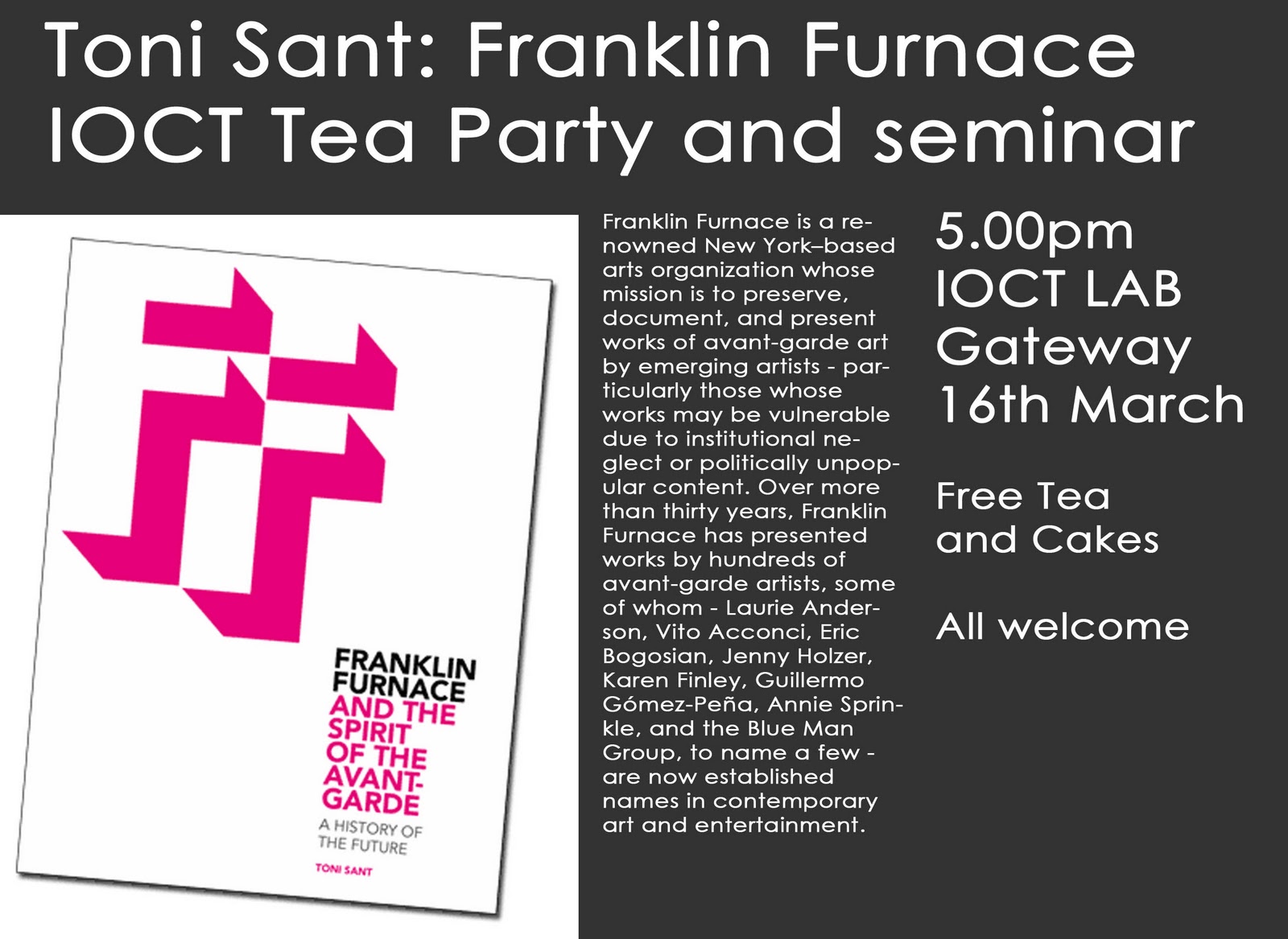
Toni Sant: Franklin Furnace


Toni Sant is Director of Research at the University of Hull’s School of Arts and New Media in Scarborough. He has also lectured about performance and new media at New York University and the University of Malta. http://www.tonisant.com

He will deliver a talk on the pioneering art of Franklin Furnace including Jenny Holzer and Laurie Anderson on wednesday 16th March at IOCT Lab on Gateway at 5.00pm


Monday, 28 February 2011

Codes of Disobedience & Dysfunctionality


The Hybrid City workshop:
 Codes of Disobedience & Dysfunctionality
 28 February - 4 March 2011

City intervention and Presentation of the work
 at the National Museum of Contemporary Art, Athens, 5 - 25 March 2011


The University Research Institute of Applied Communication (URIAC), in
collaboration with the New Technologies Laboratory of the Faculty of
Communication and Media Studies, of the National and Kapodistrian University
of Athens, organise from the 28th until the 4th of March 2011 the workshop
"Codes of Disobedience & Dysfunctionality" led by the British artist Professor Martin
Rieser of IOCT, De Montfort University, in collaboration with an interdisciplinary team of artists, researchers and postgraduate students, as part of the action "Global
Gateway" and of the EU funded program "Civil Society Dialogue - Istanbul
2010 European Capital of Culture".

The aim of the workshop is to study the elements of the urban environment of
Athens and to form a new trail as a structure of narrative, thus enriching
the city with interactive content that reflects its contemporary
transformations. Inspired by the post¬ers and the graffiti encountered in
the city, and taking advantage of the possibilities given by mobile
communication technologies (GPS, QR codes etc) and the internet, the
workshop aims to connect the urban surroundings of Athens to opinions and
statements of its inhabitants regarding the challenges imposed by current
social, political, and financial circumstances; Anger, disobedience,
opposition, dysfunctionality. The features of the contemporary metropolis in
the midst of a period of crisis will be the main focus of the project,
posing at the same time questions about the role and mediation of technology
in urban everyday life. Can the new possibilities offered by technology
really capture the needs and the atmosphere of a city like Athens? Can
patterns and characteristics of urban life be identified when studying the
use of these communication systems?

The work that will be formed after the completion of the workshop will be
presented at the premises National Museum of Contemporary Art, on the
internet and in the center of the city (at the streets Skoufa - Navarinou -
Tzavela). From the 5th until the 25th of March the visitors of the museum
and inhabitants of Athens will be invited to follow the project's trail and
discover the different parts of the project's narration. Special QR codes
will be placed in selected locations of the city and by scanning them with a
mobile phone, access to the audiovisual material created during the workshop
will be given. Combining elements of installation art, urban intervention,
gaming and performance, "Codes of Disobedience & Dysfunctionality" reflects
Rieser's long term practice on art and technology.

Tuesday, 22 February 2011

Wireless City Amsterdam

Professor Martin Rieser spoke at a Conference organized by the Mediafonds in collaboration with the Sandberg Institute at the state theatre in Amsterdam: 
Wireless Stories. New Media in Public Space
A review of the day is below. In addition he participated in a one day masterclass with 8 potential teams for the Mediafons awards (€100000 per project ) at the Sandberg institute


________________________________________________________________________


Symposium Review
By: Anja Groten

The symposium was opened by the director of the Mediafonds Hans Maarten van den Brink, followed by an introduction of the program by Annelys de Vet, director of the design department at the Sandberg Institute and moderator of the day. Annelys gave a brief insight in the current use of locative media. She spoke about physical spaces that become digital and digital spaces that are empathized more and more with the physical. As well she pointed out the current urge of the topic, which was proofed by the huge amount of visitors attending the conference (600 participants). 

The first speaker of the morning block about publicness, Michiel de Lange just finished his PHD about " Mobile Media and Playful Identities". Lange gave a rather abstract and theoretical view on "narrative" and the importance of storytelling, publicness and wireless media".
He explained the narrative relates to human identity as human life can be seen as a stage. Publicness, the physical or media space furthermore is the space for similarities, the space where we can share our stories. But publicness is also a space of differences, which provides the possibility to remain private and individual. 
With his last point wireless media as the new way of storytelling, Lange presented some actual examples, like Esther Polak's project about tracing the milk trade (milkproject.net) or the well known GPS city game Pac Manhattan. (pacmanhattan.com)
Especially Polak's project shows well how very complex and abstract content, such as the milk trade from Latvia to the Netherlands, can be translated by the use of locative media to something visual and accessible .

Dick van Dijk of the Waag Society showed as second speaker how locative media can actively involve users and how it is able to change behavior in public space. 
One of the projects he showed was 7 scenes, a city game that makes the history of Amsterdam accessible by actual experience. With this hands-on project van Dijk demonstrated that apart from research and experimentation, advanced technology can actually relate to society and is able to add value to learning processes. The idea of 7 scenes is very simple. By actual walks with the historical map of Amsterdam children could understand and remember information better than only by reading or hearing about it.

Helena Muskens and Quirine Racke were introduced by an expressive performance of Annelys de Vet who suddenly collapsed on the stage quite theatrically and apparently very convincing. Some people were hearable shocked and shouted the light should be turned on. Parts of the audience instead were less surprised and rather amused, since they were already introduced to Annelys' extra ordinary presentation methods.
Eventually the light went on again and the happening was dissolved by a movie about groups of people collapsing in public space as flashmob-actions.

Following Muskens and Racke showed their (less dramatical) movie Diamond Dancers, which is about invisibility in public space. 
The movie showed elderly ladies who are dancing together some kind of square dance on Dam Square in Amsterdam. Although the action of the dance was presented as a flash mob, the question was to expect why this was considered a flash mob since the action was rehearsed and staged and didn´t involve the use of social media. Unfortunately the question remained unanswered. 

Dimitri Nieuwenhuizen (lust.nl/lustlab.net), started as the first speaker of the second block of lectures which had the focus of Audience and Interaction. He gave a brief historical and anthropological tour of The Digital and showed amongst other examples the known Lust-project where they turned the city of The Hague into an airport. 
The question came up how the audience reacted towards the highly visible intervention, which I thought was quite an interesting question. "The pedestrians were more pleased than the shop-owners and elderly people were afraid a war would start", was the response with a little ironic undertone. The discussion of ethics, responsibility unfortunately did not occur.

After the Danish PHD student Tobias Ebsen gave a more than detailed insight in the institution he is operating in, the Center of Digital Urban Living (DUL) and the Media Facade Research Group of the University of Aarhus, Denmark. The works he showed all contained very big facades, which were transformed into interactive platforms for self-expressions of the pedestrians. The impact of the projects remained hidden behind rather sober explanation.

Matthijs ten Berge talked about Illuminate Outdoor Media and showed the Moodwall which was a 24 meter long interactive media wall installed in the Bijlmer, Amsterdam. 

Michael Epstein, CEO of Untravel Media (untravelmedia.com) as well as Martin Rieser, professor of digital creativity, (martinreser.com, thirdwoman.com) introduced a focus on storytelling, playfulness and gaming by using mobile technologies.

Epstein showed with three projects how crime plots and dystopian fiction can literally become real. In "A Machine to See With" the user is player and actor at the same time. Guided and followed by a voice, which could be the voice of some kind of "Big Brother melted with your therapist", the users was physically involved in a bank robbery and sometimes even met other players/actors on the same mission.

Rieser gave some insights in The Third Woman, a dynamic crime story with three alternative scripts which the user could choose from. The scripts are written in fragments of about a minute. The more fragments watched the closer a resolution of the mysterious "Third Woman".

While most of the talks were showing new media as a playing field of experimentation in a creative but very abstract way, the last talk A sense of Place by Bregtje van der Haak changed the perspective on the subject matter to a very personal and observing one.
Coming back from six month of teaching and living in Hong Kong she presented images and small videos of her observations. Those images were selected in a way they were telling not only the story of her stay, but a story of a society which functions and behaves totally different than our western society does. She spoke about people she met and their stories, about the world as their stage, about the believe in the after-life as an actual place and part of the whole, about the story of migrant workers and their networked life and about the new center of the world, China.

It seemed the previous talks created a consent as they all embraced technologies such as locative media as an exciting and new field to explore. Hence the similarity of the lectures sometimes gave the impression of repetition. 
The personal approach of the last talk instead added new perspectives and insights to the subject matter and was the perfect ending of the whole event.


Thursday, 3 February 2011

Greenview Bid Success

Greenview

A £40,000 joint bid between IESD and IOCT  to JISC for energy use visualisation through mobile phones and augmented reality has been successful

Overview

Greenview aims to follow on and build on the successful DUALL project, funded by phase 1 of JISC's Greening ICT call. DUALL utilised a socio-technical solution to the design of a simple web based information-feedback tool that could report electrical consumption of ICT equipment back to users. Greenview aims to refine the ICT tool further into a more sophisticated smart phone application that connects staff and students in De Montfort to the energy consumption of their buildings.


Aims and objectives

Aim: To design a leading edge smart phone and web based application enabling building users to understand the energy consumption of the buildings across DMU.
Objectives:
  1. To design and launch a campus wide ICT tool connecting building users to the energy consumption of buildings and the ICT infrastructure.
  2. To help the extent building users impact the performance of the environment they are in.
  3. To understand the potential of augmented reality tools to engage individuals in behaviour change initiatives. 
  4. To engage the creative and developer community at DMU in sustainability issues

Project methodology

The project will gather the information from sub-meters across the campus which monitor half-hourly electricity, gas and water.
Software will incorporate the design of major interface components, including collaborative gaming elements, display alternatives, (adaption of map-based and Augmented reality systems for mobile platforms using GPS) using streamed data sets from intelligent metering and its required interpretive software.
Technology such as social media, augmented reality, GPS technology, and wiki or crowd-sourcing knowledge approaches to engage with the public in what we would term "hybrid " city environments.
This ability to reach out and map layers of information onto the cityscape will form the foundation for further developments to support this bid. Pilot interface tests will occur in situ with a variety of controlled groups for evaluation in set scenarios of components: display overlays, collaborative elements etc.
Finally, the tool will be launched across the campus and a rigorous analysis undertaken based on the evidence of any changes to consumption (as shown in the meter readings) and interviews.

Anticipated outputs and outcomes

We anticipate that the outcomes of the project will form an institutional exemplar project that places sustainability at the core of DMU's CSR agenda, and connects into the aim of the JISC Institutional Innovation Programme to provide "improved leadership to the sector in the role that technology can play in developing effective institutional strategies."
Specifically there will be a campus wide ICT tool (using augmented reality) connecting building users to the energy consumption of buildings and the ICT infrastructure. This will be open source and available for download by other HEIs.

Project Staff

Project Manager: Dr Richard Bull IESD (DMU)

Project Team:

Professor Martin Rieser
Institute of Creative Technologies (DMU)


Dave Everitt
Institute of Creative Technologies (DMU)


Gareth Howell
Institute of Creative Technologies (DMU)


Farhan Faruk
IESD (DMU)